
Volume Three: Inkblots & Interpretations
What makes movies and books about serial killers so popular?

Dear Subscribers,
Welcome back to Volume 3 of Inkblots & Interpretations!
Ink-spot Musings…

Why are we Fascinated by Stories about Serial Killers?
This is not a new question. Much has been written about our collective fascination, bordering on obsession, with serial killers.
If you Google serial killers or, more specifically, popular media about serial killers, you’ll encounter countless pages of books, films, TV series, and documentaries.
In this issue of Inkblots & Interpretations, I examine what makes movies and books about serial killers so popular.
Whispers
I became interested in this subject matter because my recently completed novel, Whispers––a sequel to Tears Are Only Water––involves the hunt for a serial killer targeting none other than…psychiatrists.
Here are a few words about the story….
Whispers follows former Deputy Nicola Kitts, now a Special Agent Kitts with the FBI’s Behavioral Assessment Unit (BAU). Still haunted by her unresolved trauma, Kitts struggles to keep personal demons at bay in her gripping pursuit of a killer called The Whisperer, who leaves complex mathematical equations and twisted poems at each of the crime scenes.
The mathematical angle allows Kitts to call on her old friend Carmine Luedke, the protagonist math savant from Tears Are Only Water.
This is an evocative cover design concept that I’m playing with:
WHISPERS
A Tale of Madness, Betrayal, and Revenge
J. Herman Kleiger
Sequel to Tears Are Only Water

Due to be released in 2025.
Our Fascination with Serial Killers
My interest in writing a novel about a serial killer unfolded naturally. Readers encouraged me to write a sequel to Tears Are Only Water, and I thought Deputy Nicola Kitts was an interesting character who would support a sequel.
As I mentioned, the story places Kitts at the center of an investigation into the deaths of several prominent psychiatrists.
That such a deliciously dark story emerged from my imagination (unconscious) made me wonder why so many of us are held captive (a choice description) by stories about serial killers. Thoughtful people have asked what it is about serial killers that piques our interests and won’t leave us alone.
The interest is truly astounding. Well before the book and series Mindhunter and Criminal Minds, there were dramatic series (Dexter, and more recently Hannibal and You) and documentaries (Ted Bundy: Falling for a Killer, Zodiac, Conversation With a Killer: The Jeffrey Dahmer Tapes, and Myra Hindley: Britain’s Most Notorious Female Serial Killer). These are only a few examples of what you’ll find.
Literature about serial killers from the 19th century includes The Case of the Murderous Dr. Cream, Dean Jobb, and, of course, numerous books on Jack the Ripper, including The Complete History of Jack the Ripper by Philip Sugden.
I’ll include a link to top recommended books and popular media about serial killers. However, digging into this subject is a rabbit hole of never-ending stories about this special variant of true crime.
Why the Interest?

Vatsa Singh wrote about our obsession with serial killers and concluded that our fascination with true crime gives us an adrenalin rush.
Similarly, Professor Brett Nava-Coulter, who teaches a class at Tufts on The Sociology of Violence, explains our obsession with stories about serial killers to “spark excitement, shock, and fear.”
Most of us can relate to these seemingly apparent conclusions. That’s why we read thrillers, right? Many of us can’t look away. Like slowing our cars to stare at an accident, we can’t seem to get enough of stories about serial killers. But in addition to providing thrills, serial killer stories offer intrigue and suspense––a spine-tingling puzzle to be solved.
The allure has to do both with our individual psychology as well as with cultural themes.
Culturally, stories about serial killers have mass appeal. They sell. As an art form, serial killer fiction mimics the violence in our society and depicts the conflicting themes of crime and retribution, security and danger, and good and evil. The tension between opposing themes can be pretty compelling for people.
But in terms of our individual psychologies, crime fiction also exists in the space between reality and fantasy. Again, it is this tension that makes crime fiction so appealing to readers/viewers.
Regarding the fantasy aspect, Nava-Coulter notes that such stories can serve as antidotes to our boring routines and humdrum lives. Like all fiction, suspenseful crime stories offer an escape from the monotony of our day-to-day lives. They transport us to another place.
At the same time, a fascination with serial killers generally ignores the horrendous reality of their crimes and, in some cases, even glorifies them. This is more the case with fictional depictions than with documentaries.
Still, in both cases, we often suspend our horror and moral judgment, perhaps partly because this is happening to someone else––the unsuspecting person alone in their home or hitchhiker along the lonely highway. We are relieved that this is happening to someone else.
We generally don’t like our enjoyment spoiled by things becoming too real. For example, a T-bone steak is a great pleasure as long as we don’t think about the realities behind factory farming and the slaughterhouse.
What Our Fascination Tells Us About Ourselves
Apart from the thrills and the tension between the real and the unreal, what do we find so satisfying? And, more interestingly, what needs might these stories address?

In his article in Psychology Today, Richard Lettieri, Ph.D., a psychoanalyst and forensic psychologist, speaks about “the seduction of criminal forensic psychology is for me in the baseness of it all.”
Lettieri describes the “rendezvous with something that is hidden in all of us - what Freud called the Id.”
A traditional psychoanalytic explanation might look at the tension between the dark and unrestrained forces of the Id and the socially adaptive and moral dictates of the Ego and Superego (conscience). Sound familiar?
As mentioned above, tension can pique interest. Many people are drawn to the Manichean battle between good and evil. Which side we root for is another matter––the good, the bad, or maybe, both.
The hunt or pursuit makes for a good story. Serial killers select their victims, and we, along with law enforcement officials, need to figure out why. Why were they chosen? Is there a pattern?
The police or FBI agents pursue the killers and often encounter false leads and dead ends. We become engaged and identify with characters. What leads would we pursue? How would we protect ourselves as potential victims? And what would we do differently if we were the killers?
Here, I’m thinking of the popular series The Jackal and Killing Eve, where we might think about how we would cover our steps to evade law enforcement. Again, this works as long as the stories don’t become too real.
Stories about serial killers and those who pursue them provide vicarious satisfaction for both the predators and the protectors. Crime writer Ava Strong uses these terms to describe both kinds of hunters––those who are good and seek to find and stop the killers and those who embody our worst fears and nightmares.
Some may quietly root for the killer to continue to defy societal norms and evade law enforcement officials who hunt for them. Early 20th-century psychoanalyst Carl Jung posited that we all have a “shadow self” side of our personality, which is an elaboration of the Freudian concepts of Id, Ego, and Superego.
Jung used the term Shadow Self to describe the unconscious reservoir of fears, wishes, and traits that conflict with our prosocial attitudes and values. In other words, all of us possess a hidden, darker side, which is held in check by our allegiance with societal norms, rules, and values.
But secretly rooting for the “bad guy” isn’t unusual. Readers and viewers may admire the vengeance-seeking characters like Dexter, who eliminates more despicable individuals, or the cleverness and utter lack of conscience of Villanelle, the female killer in Luke Jennings’ Killing Eve Series.
In either case, one may experience a vicarious pleasure as the serial killer eludes detection and capture and gets away with murder. It’s even more compelling when the victims have it coming, as is the case with the vigilante Dexter Morgan.
Novelist Joanna Schaffhausen speaks of the tension in the awareness that we are enjoying our alignment, and even identification, with a serial killer.
“We ride along with the serial killer and we kill with them, and then we have to sit there with that, like ‘How do I feel about the fact that this is my window into this story?’” Schaffhausen said. “You get this moral ambiguity, which is very interesting and compelling.”
Of course, most of us probably root for the “good guys,” cheering them on as they hunt down the worst of the worst. In these stories, the killers are so evil that we eagerly anticipate the moment of delicious justice and retribution.
I’ve found myself experiencing this feeling when watching or reading about the FBI or police who doggedly pursue serial killers. Think about the memorable Jodie Foster character, Agent Clarice Starling, in Thomas Harris’ classic The Silence of the Lambs, who pursues the twisted serial killer called Buffalo Bill.
The Silence of the Lambs is an interesting example where one can root for the good (Clarice Starling) and, of course, the charismatically wicked Hannibal Lecter, ghoulishly brought to life in the film by Anthony Hopkins.
Like climbing on a rollercoaster, reading or watching a story about serial killers offers thrills as we pursue something risky and dangerous and walk away unscathed. But even more importantly, they also allow us to master those fears.
We’re exposed vicariously to scripted and make-believe danger, grappling with the tension between good and evil, danger and safety, and crime and punishment, all of which we watch from a safe distance.
And unlike the victims in the stories, we lock our doors and walk away.
Wounded Predators and Protectors
Years ago, the Washington Psychoanalytic Society hosted a weekend workshop on Evil as part of its New Directions program for writers. Renowned psychoanalyst Salman Akhtar was a key speaker.
In attempting to understand the workings of the minds of evil-doers, Dr. Akhtar said, “Show me a serial killer, and I’ll show you an abused child.” This was a more profound way of saying “hurt people hurt people.” Understanding what gives rise to evil helps explain its origins without excusing it.
The protectors are often depicted as wounded individuals as well, whose personal history of trauma serves as a deeper motive for rooting out evil and bringing killers to justice. Ava Strong’s protagonist, Ilse Beck, both a mental health professional and FBI agent, was severely traumatized as a child.
The same is true for her partner, Agent Tom Sawyer. Their own histories of trauma lurk in the background and drive the narrative, providing hidden motives in their pursuit of serial killers.
The theme of woundedness and past trauma is present in both the predators and protectors in Whispers. Agent Nicola Kitts carries past trauma within while seeking to bring evildoers to justice. The reader will see Akhtar’s words play out in those who do the killing.
But the idea that all hurt people go on to repeat the hurt they experienced is contradicted by the wounded protectors who seek to achieve belated mastery over their own trauma by protecting potential victims and preventing further hurt, abuse, and killings.
What to Watch and Read
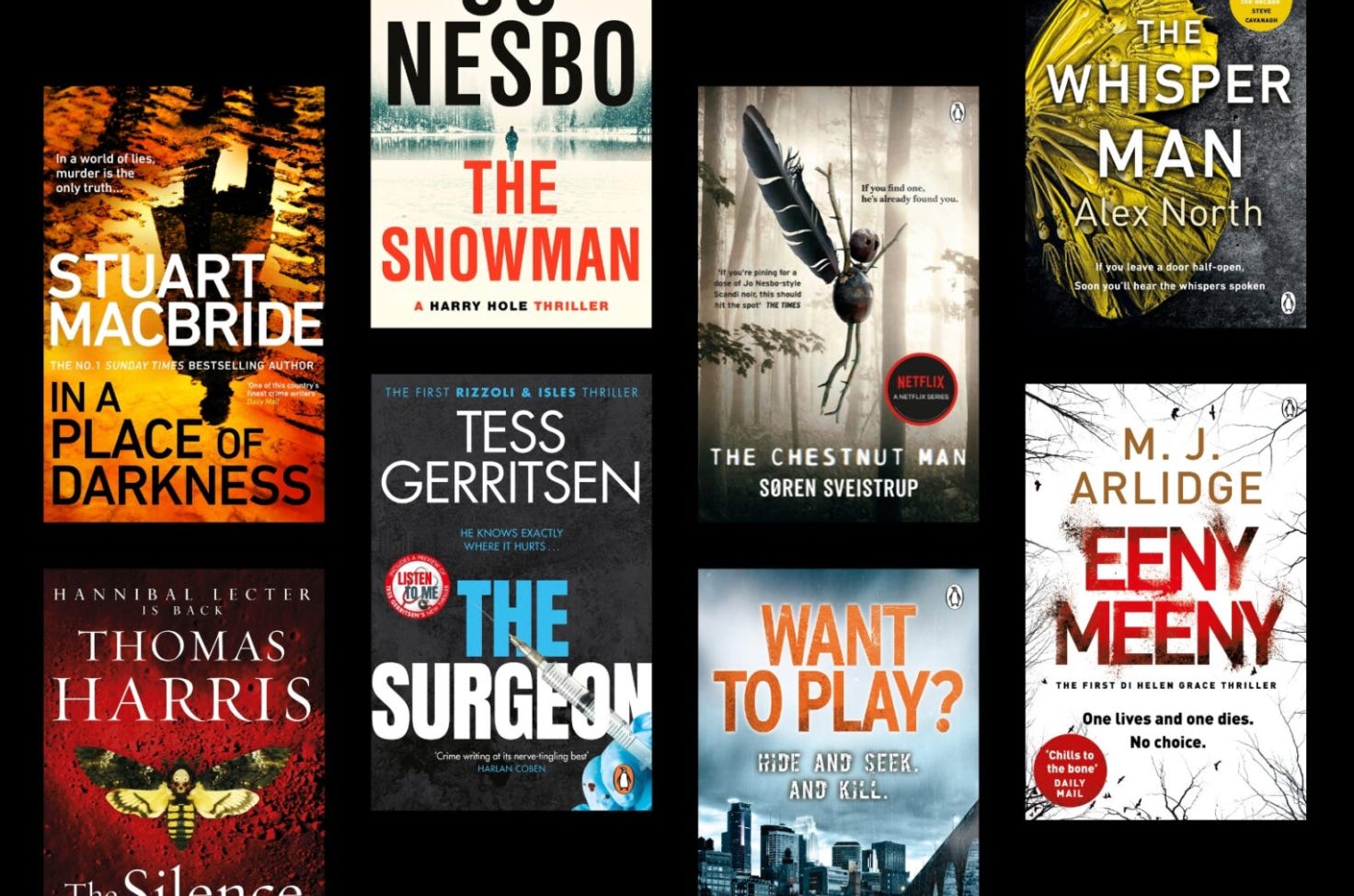
Here’s a short sampling of Goodreads picks for top books on serial killers.
1. The Silence of the Lambs, Thomas Harris
2. Not Like Us, Ava Strong
3. Intensity, Dean Koontz
4. The Bone Collector, Jeffrey Deaver
5. The Girl With the Dragon Tattoo, Stieg Larsson
Most, if not all, have been made into movies.
I would also recommend Ava Strong’s books with female Special Agents Dr. Ilsa Beck and Dakota Steele. Strong’s wonderful writing weaves together compelling characters who embark on page-turning quests to profile and hunt serial killers.
For nonfiction, it’s hard to find anything better than Mindhunter by John E. Douglas and Mark Olshaker and The Night Stalker: The Disturbing Life and Chilling Crimes of Richard Rameriz by Philip Carlo.
Prologue to Whispers
In my last newsletter, I previewed a teaser for Whispers, which is due out this year. I’ve since tweaked it and include the latest version as a sample of what’s to come.
Prologue
May 20, 2023, Georgetown, Washington, DC
Most people can’t recall the smell of blood. Caralena couldn’t until she walked into the doctor’s office at 7:00 PM. His was her last suite to clean, but the door to his waiting room was left ajar. No one entered without pressing the four-digit code into the keypad by the door. Curious, she scanned his waiting room.
Everything was in place––dimly lit as usual, a shabby shrink décor with an eclectic mix of modern and ancient furniture. There were the overstuffed IKEA faux leather chairs and a ratty end table with a towering stack of magazines, mostly with covers tattered and torn.
Pictures of the seashore were strategically positioned on each wall to soothe and offer comfort to those about to enter. Each time Caralena walked through the doorway with her vacuum, she couldn’t help picturing the cramped examining rooms of the kind old urologist who used to occupy Suite 44 before the psychiatrist took over the lease and reconfigured the spaces.
“Hellooo? Doctor? …. It’s me, Cara here to clean. Are you in there?” Recalling that he occasionally worked late, she said, “I can come back later if you’re still working.”
His office door was cracked open, exposing the beige wall to his inner sanctum, where she believed important doctors healed their sick patients. As she approached, she was assaulted by a sickeningly sweet, metallic smell that no one should know, but everyone does. She had forgotten what her senses never had. Her mind was in a jumble as she lightly tapped the door. “Doctor?”
Pushing it open, she looked inside and began to retch…
Novels by J. Herman Kleiger
Jhermankleiger.com

Thank you for reading!
Fantastic post! I've always wondered what that fascination is - I avoid anything violent, but my kids are huge fans of anything horror.